Most exterior materials don't fail in obvious ways. They fade. They loosen. They start needing small fixes that turn into regular attention.
Durability shows up differently. It's quieter. A durable exterior keeps doing its job without asking for it to be noticed.
That's why durability matters when choosing steel panels for a roof or a wall. Not because of how they look when they're installed, but because of how they behave years later — after weather, sun, and time have had their say.
MM Steel panels are designed with that expectation in mind. Not durability as a promise, but durability as a baseline.
"Exterior materials don't fail all at once. They wear down quietly."
Durability Isn't a Feature — It's a Long View
When people talk about durability, they often point to a single detail: gauge, paint, thickness, or a rating on a spec sheet.
But durability isn't one thing. It's the outcome of many decisions made long before a panel is installed — and proven long after.
A durable panel holds its shape under load. It resists impact. It keeps its finish intact through repeated exposure. It doesn't ask for constant maintenance to stay functional.
Most MM Steel panels can be used for roofing or siding, depending on the profile and application. Woodgrain is the exception — it's a siding product, designed specifically for vertical applications.
Regardless of use, durability means the same thing: predictable performance over time.
"Durability means predictable performance over time."
Where Durability Actually Starts
Every steel panel begins with the steel.
Pro-Rib®, Premium Pro-Rib®, and Premium Pro-Snap® panels are formed from structural steel that meets ASTM A653 requirements. That standard exists for one reason — to ensure consistency and performance in exterior building applications.
This matters because durability isn't something that gets added later. It's rooted in the material itself. When steel meets structural standards, its ability to carry load and resist deformation is inherent.
That's why steel panels are used across residential, agricultural, and post-frame construction. The expectation is stability — not just at installation, but over the long haul.
What Makes a Steel Panel Hold Up Outdoors
Steel panels don't live in controlled environments. They live outside.
Sun exposure, moisture, temperature swings — all of it tests the finish long before it tests the steel. That's why finish performance plays such a large role in how a panel ages.
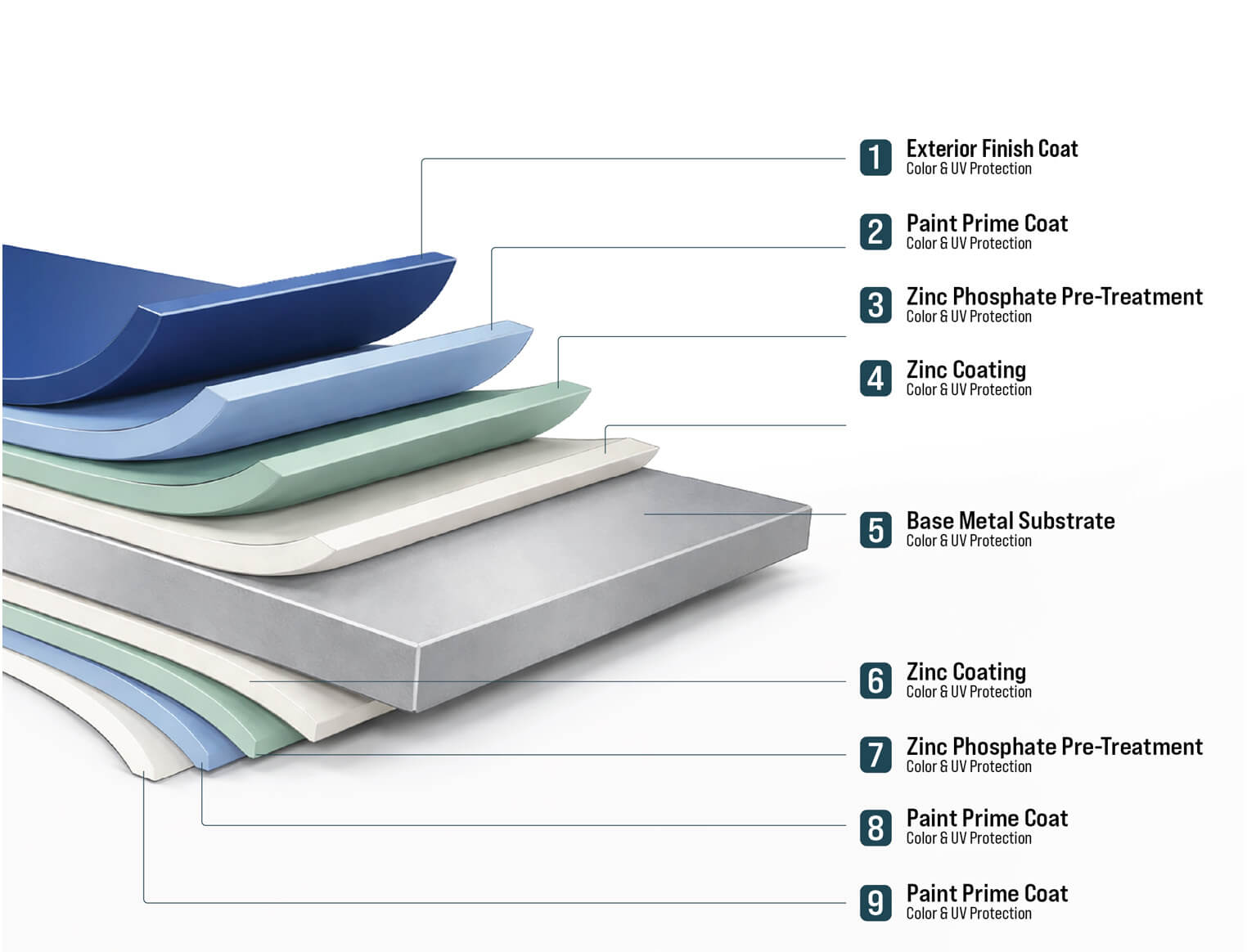
MM Steel panels are formed from pre-coated steel intended for exterior exposure. Those coatings are specified to meet ASTM A755 requirements, which govern how finishes are expected to perform outdoors.
What that means in practice is simple:
Finishes that stay adhered
Color that holds under sun exposure
Surfaces that don't require constant attention to stay intact
Durability shows up when those things remain true year after year.
Steel panels are formed from pre-coated steel designed for exterior use. This diagram highlights the types of protective layers involved, not exact dimensions or proportions.
When Finish Choices Matter
All MM Steel panels share the same structural foundation. Where they differ is in how long the finish is expected to hold its appearance.
Pro-Rib panels are designed for dependable exterior performance and backed by long-term warranties that reflect that expectation.
Premium Pro-Rib and Premium Pro-Snap use the same color offerings, but with a thicker finish and longer warranty coverage. The difference isn't visual on day one — it shows up later, as the finish continues to perform.
The Designer Series refers to matte finish options available across these same panel profiles. The appearance is different. The performance standards are not.
Woodgrain panels follow a different path. They're intended for siding applications where a consistent wood look is desired without ongoing maintenance cycles.
Each option is about matching appearance expectations with long-term performance — not creating tiers for the sake of it.
When Conditions Stop Being Ideal
Durability becomes obvious when conditions aren't.
High winds don't announce themselves ahead of time. Hail doesn't wait for a warranty brochure. Fire resistance isn't something you think about until it matters. These are the moments when materials stop being theoretical and start being tested.
That's why steel panels aren't judged only by how they look, but by how they perform when conditions push back.
For our Pro-Rib, Premium Pro-Rib, and Premium Pro-Snap panels, that performance is verified, not assumed.
They meet UL 580 Class 90 standards for wind uplift, a rating that reflects how roof assemblies respond when wind tries to lift them away from the structure. In open terrain or exposed sites, that resistance is part of what keeps a roof doing its job quietly.
Those same panel families also meet UL 2218 Class 4 impact resistance—the highest rating in that standard. It's designed to measure how materials respond to hail impacts that would damage or compromise lesser surfaces.
And because steel does not contribute fuel to a fire, these panels meet UL 790 Class A fire resistance for applicable assemblies. That's the highest fire classification recognized for roofing materials.
None of these ratings change how a panel looks on day one. They change how it performs when it counts.
"Durability becomes obvious when conditions aren't."
Why Standards Matter More Than Claims
It's easy to say a product is durable. It's harder to prove it in a way that holds up.
Standards like ASTM A653 and ASTM A755 exist to remove guesswork. They define what structural steel must meet, how exterior finishes are expected to perform, and how consistency is maintained from one coil to the next.
When steel panels meet these standards, durability stops being subjective. It becomes measurable.
That's also why building codes reference them. IBC 1507.4, for example, establishes requirements for metal roof panels used in construction. These benchmarks aren't marketing tools—they're guardrails that define acceptable performance.
For homeowners, they provide something simpler: confidence that the material on the outside of the building wasn't chosen arbitrarily.
What Warranties Actually Say About Durability
A warranty doesn't make a product durable. It reflects what the manufacturer expects the product to do over time.
That's why warranties play an important role when choosing steel panels. They're not covering something that's meant to wear out quickly. They're documenting performance expectations that stretch decades into the future.
For Pro-Rib, that expectation includes:
A 40-year limited warranty on paint film integrity
30-year limits on fade and chalk performance
For Premium Pro-Rib and Premium Pro-Snap, the expectation extends further:
A Limited Lifetime paint film warranty for the original purchaser
Extended fade and chalk performance through 35 years
The color choices don't change between Pro-Rib and Premium. What changes is how long the finish is expected to maintain its appearance under continuous exposure.
Woodgrain panels follow a different warranty path because they serve a different purpose. They're siding panels, designed to deliver a consistent wood look without the maintenance cycles that come with real wood. Their 20-year limited warranty focuses on print and coating performance, which is where durability shows up for that application.
Each warranty tells a slightly different story—but they all point in the same direction: long-term performance is not assumed, it's defined.
"Durability is what you don't have to think about."
Durability Is What You Don't Have to Think About
The real value of durable exterior materials shows up slowly.
It shows up when there's no repainting schedule to plan around.
When fasteners stay tight. When finishes don't demand attention just to look acceptable. When repairs are rare instead of routine.
Steel panels are often chosen for exactly that reason. Not because they're flashy, but because they simplify ownership.
That long-term reliability also ties directly into topics we've covered elsewhere—how steel strength goes beyond gauge alone, and how steel roofing compares to asphalt shingles over time in terms of comfort and efficiency.
Durability is the through-line that connects all of it.
Built for Where They're Used
Weather in the Midwest is rarely predictable. Materials are expected to perform through wind, heat, cold, and impact—often in the same year.
MM Steel panels are designed with that reality in mind. They're made to perform consistently without constant attention, and they're available through Menards®, making them accessible whether you're planning months ahead or responding to a project now.
Choosing Steel with the Long View in Mind
Steel panels aren't chosen for a season. They're chosen for what comes after.
When durability is treated as a baseline—not an upgrade—it changes how a building ages. The exterior does its job quietly, year after year, without asking to be noticed.
That's the kind of performance steel panels are expected to deliver. And it's the expectation MM Steel builds around.
MM Steel roofing and siding panels are available at Menards locations across the Midwest. Explore options online or visit a store near you to see profiles, finishes, and trim options in person.